Agentic Starter
Availability information
The Agentic Starter template requires GenAI and MLOps functionality. If you do not currently have access to these features, sign up a 30-day DataRobot trial to try out this template.
Access this application template on GitHub
The Agentic Starter template provides a ready-to-use application for building and deploying agentic workflows. It includes support for multi-agent frameworks, a FastAPI backend, and a React frontend. The agent connects to MCP (Model Context Protocol) servers as a client, so it can use tools from the DataRobot Global MCP or from a standalone server built with the MCP Server template. The Agentic Starter template provides a ready-to-use application for building and deploying agentic workflows. It includes multi-agent frameworks, a FastAPI backend server, and a React frontend. The agent connects to MCP (Model Context Protocol) servers as a client, so it can use tools from the DataRobot Global MCP or from a standalone server built with the MCP Server template. You can set up a new agentic application with minimal configuration, develop and test it locally, and deploy it to DataRobot with one command.
The template ships with a Blog Content Writer agent as a working reference implementation. Given a topic, this two-agent LangGraph workflow first runs a Planner that researches the subject and produces a structured outline with key facts and suggested sources, then hands off to a Writer that transforms that outline into a concise, publication-ready blog post in markdown format. The agent can optionally use MCP-hosted tools to look up accurate and up-to-date information during both planning and writing stages. This end-to-end example demonstrates multi-agent orchestration, tool use, and the planner to writer handoff pattern—all of which you can adapt or replace with your own domain-specific agents and workflows.
Use this template when you want to:
- Build custom agentic applications with reasoning engines (e.g., LangGraph) that plan tasks and call tools.
- Connect your agent to MCP servers so it discovers tools, resources, and prompts at runtime via the MCP protocol.
- Run a full stack locally—frontend, backend, and agent—with a single command (
task dev) after configuration. - Deploy the entire application to DataRobot with
dr task run deploy.
The template uses the dr start CLI wizard to guide you through configuration (API endpoint, keys, ports, database, OAuth, and LLM integration). After setup, you get a .env file and an application directory; you can then run task dev to start all components or run individual services (e.g., task agent:dev).
MCP server no longer bundled
Earlier versions of the template included an MCP server in mcp_server/. Current versions don't: set the MCP server for your agent in .env instead (see Configure MCP server connection). If you update an app that already deployed the bundled server, follow the template's MCP migration guide.
Key features
- Multi-agent frameworks—Integrate with agent frameworks (e.g., LangGraph) for planning and tool use.
- FastAPI backend and React frontend—Production-ready web application with a modern UI for interacting with your agent.
- MCP client support—The agent connects as an MCP client to the DataRobot Global MCP, a standalone MCP server deployed in DataRobot, or any other MCP endpoint. It discovers tools at runtime.
- Guided setup—The
dr startwizard configures API credentials, ports, database, OAuth, and LLM in one flow. - Local and production—Develop locally with
task devand deploy to DataRobot withdr task run deploy; deployment outputs include the agent endpoints. - MLOps hosting and governance—Deploy and monitor your agent within DataRobot.
Use cases
Review some use cases that are suited for using the Agentic Starter template:
-
Custom agentic workflows: Build agents that use LLMs to plan tasks and call DataRobot or custom tools (e.g., projects, deployments, predictions) via an MCP server.
-
Tool-augmented assistants: Connect agents to a shared MCP server so multiple agents or clients (e.g., Cursor, Claude Desktop) can use the same tools.
-
Full-stack agent applications: Ship a complete application (UI, API, agent) from a single template with minimal configuration and one-command deploy.
Architecture
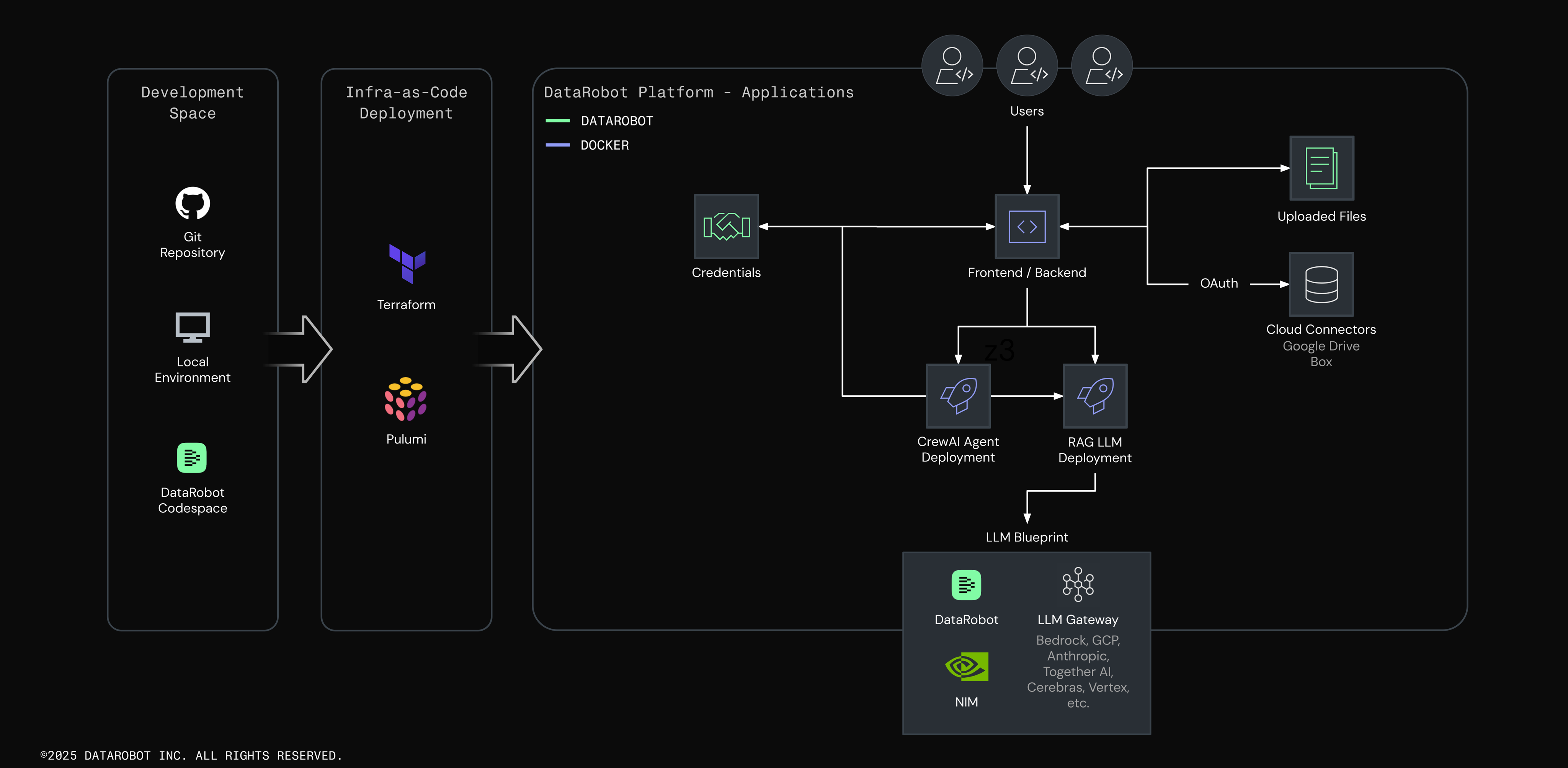
This template provides an end-to-end agentic application architecture: frontend, backend, and agent runtime, from local development to production deployment in DataRobot, while remaining customizable for your business requirements. The agent reaches its tools through the MCP server you connect it to.
Warning
Application templates are intended to be starting points that provide guidance on how to develop, serve, and maintain AI applications. They require a developer or data scientist to adapt and modify them for their business requirements before being put into production.