Deploy agentic tools
When building agents, you often need to integrate tools to handle tasks critical to the agent workflow—typically for complex use cases involving communication with external services. While some tools are embedded directly in the code of an agentic workflow, other tools are deployed externally and called by the agent process. Because externally deployed tools can scale independently, they are well-suited for resource-intensive operations, I/O-bound tasks, and reusable functionality. Deploying tools externally also enables production-ready monitoring, mitigation, and moderation capabilities in Console.
Global agentic tools
The following global tools are available for deployment to Console:
Identifying tools
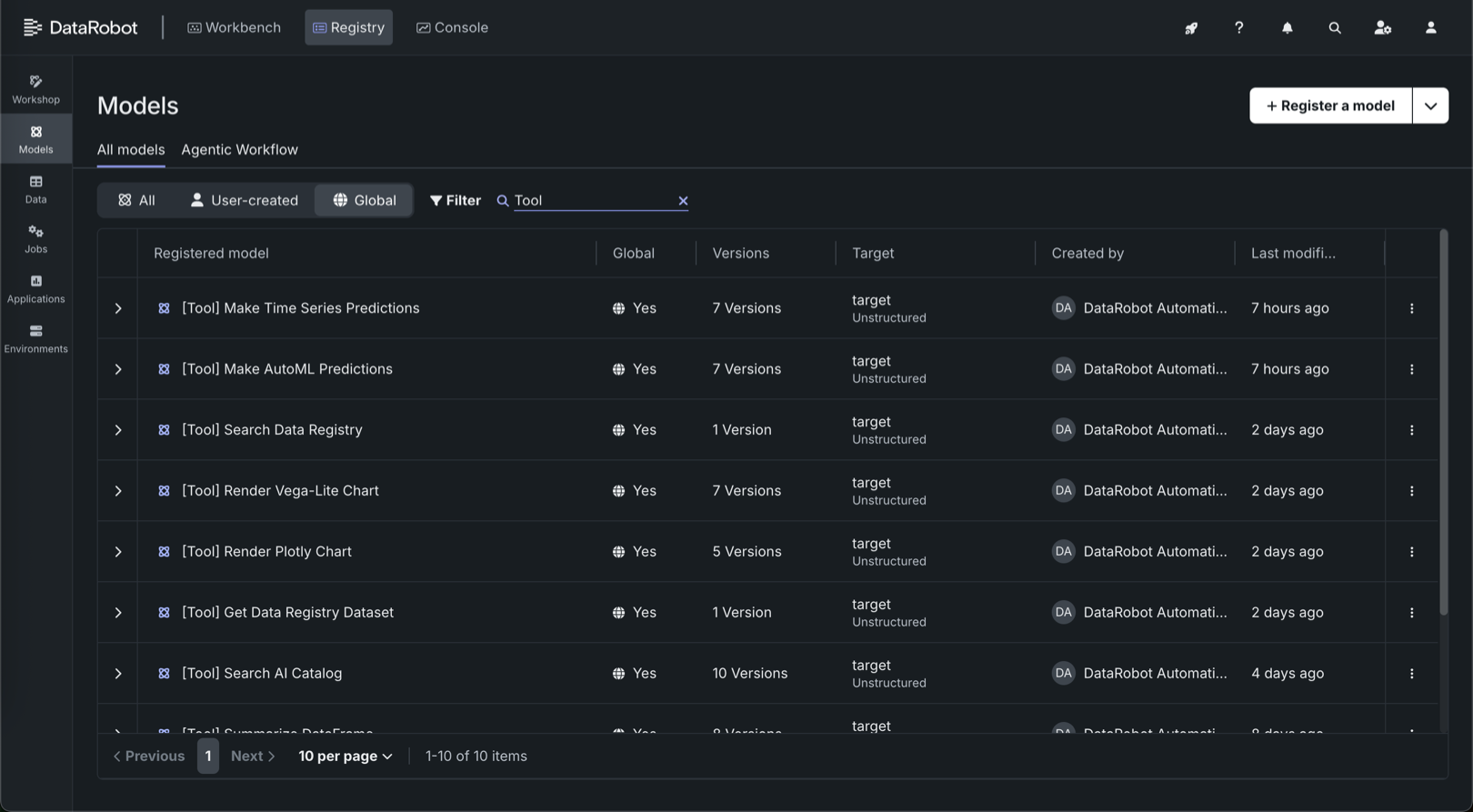
All global tools are prefixed with the [Tool] identifier. Use this identifier to filter the global models and tools list to show only tools.
| Tool | Description | Notes |
|---|---|---|
| Get Data Registry Dataset | Retrieves datasets from the DataRobot Data Registry using a dataset_id and returns the dataset in CSV format as raw bytes. |
N/A |
| Make AutoML Predictions | Accepts a pandas.DataFrame and uses that data to return a prediction from the specified predictive model. |
The argument columns_to_return_with_predictions tells the tool to return columns from the input dataset. Use this to make sure you can interpret the predictions. For example, you may want to return an ID or other identifying column so that you can see which prediction is which because you can't rely on the index or order of the predictions. |
| Make Text Generation Predictions | Accepts a string and returns a prediction from the specified DataRobot text generation model (LLM). | Suitable for tasks like summarization or text completion. This tool should only be used for TextGeneration deployments and not for regression, classification, or other target types. |
| Make Time Series Predictions | Returns forecasts from a time series model. | Before using this tool, verify that you have all the data needed. Time series models require a forecast point. They also have specific requirements for the input data. |
| Render Plotly Chart | Returns a JSON object containing a rendered Plotly chart object generated based on the provided specification and dataset ID. | When generating the Plotly chart, placeholders in the specification—indicated by double braces enclosing a column name (for example, {{ column_name }})—are replaced by the corresponding values from the specified column in the Data Registry dataset. The Data Registry dataset is identified by the dataset_id input parameter. |
| Render Vega-Lite Chart | Generates a Vega-Lite chart by passing in the Vega-Lite specification in JSON format and returns JSON with a base64-encoded image of the chart. | To provide data for the chart, pass in the Data Registry dataset_id for the dataset you want to chart. |
| Search Data Registry | Searches for datasets in the DataRobot Data Registry using search terms. Returns matching datasets as a pandas.DataFrame. |
The Data Registry does not support partial matching. If this tool doesn't return the expected results, try again with a more specific search query. |
| Summarize DataFrame | Provides a detailed summary of a pandas.DataFrame in Markdown format, including statistics and data insights. |
N/A |
Agentic tool target type
All global tools have an Unstructured target type and a Target of target.
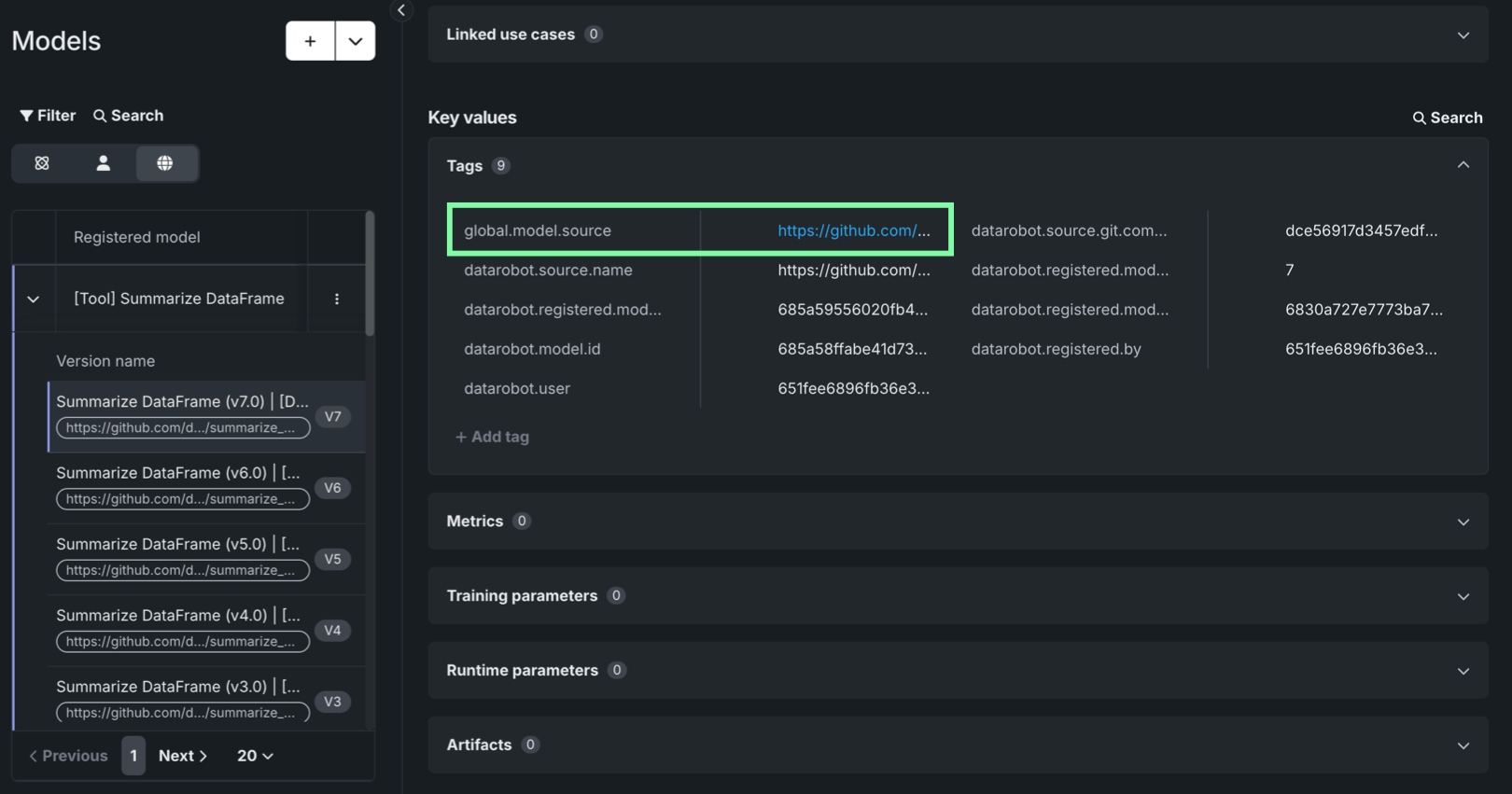
To learn more about a tool, you can access the source code in the public agent-tool-templates repository. Each tool is tagged with the global.model.source tag, linking to the directory containing the source files for that tool. This allows you to explore its contents to learn more about the model, review its input and output schema, or use the code as a template for building a customized tool. To find the repository link:
-
Apply the Global filter and look for a [Tool] in the list.
-
Open a version and in the version, scroll down to the Key values section.
-
Open the Tags panel and locate the
global.model.sourcetag. -
Hover over the tag value to view the full URL, or, click the link to open the repository to the directory for that tool.