Fundamentals of predictive modeling
This section describes DataRobot's predictive solutions; see Predictive workflow overview for a generalized discussion of the steps to build predictive models. See Get started with GenAI for an overview of working with generative AI-related tools and options.
Predictive AI uses automated machine learning (AutoML) to build models that solve real-world problems across domains and industries. DataRobot supports many different approaches to ML modeling—supervised learning, unsupervised learning, time series modeling, segmented modeling, multimodal modeling, and more. This section describes these approaches and also provides tips for analyzing and selecting the best models for deployment.
This section describes predictive modeling methods. See the Workbench predictive model training overview for a generalized discussion of the steps to build predictive models.
Predictive modeling methods
ML modeling is the process of developing algorithms that learn by example from historical data. These algorithms predict outcomes and uncover patterns not easily discerned. DataRobot supports a variety of modeling methods, each suiting a specific type of data and problem type.
Supervised and unsupervised learning
The most basic form of machine learning is supervised learning.
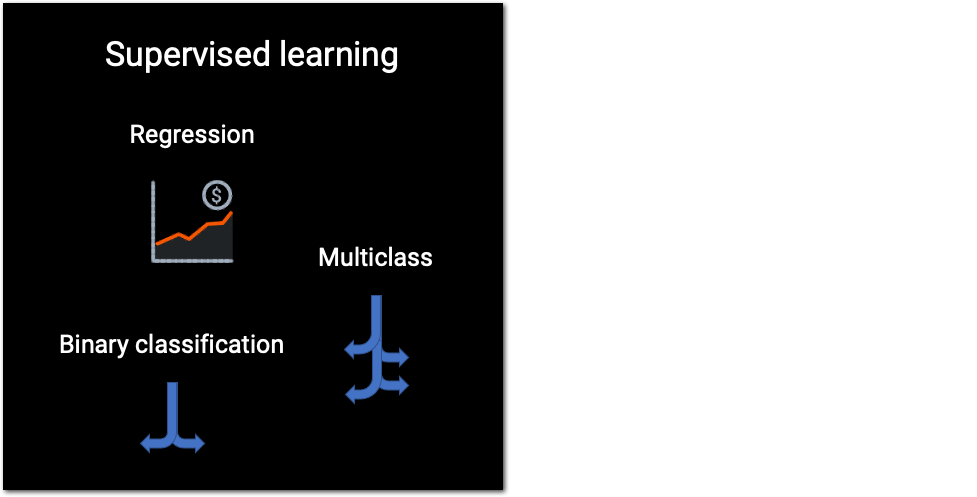
With supervised learning, you provide "labeled" data. A label in a dataset provides information to help the algorithm learn from the data. The label—also called the target—is what you're trying to predict.
-
In a regression experiment, the target is a numeric value. A regression model estimates a continuous dependent variable given a list of input variables (also referred to as features or columns). Examples of regression problems include financial forecasting, time series forecasting, maintenance scheduling, and weather analysis. Regression experiments can also be handled as classification by changing the target type from numeric to classification.
-
In a classification experiment, the target is a category. A classification model groups observations into categories by identifying shared characteristics of certain classes. It compares those characteristics to the data you're classifying and estimates how likely it is that the observation belongs to a particular class. Classification experiments can be binary (two classes) or multiclass (three or more classes). For classification, DataRobot also supports multilabel modeling where the target feature has a variable number of classes or labels; each row of the dataset is associated with one, several, or zero labels.
Another form of machine learning is unsupervised learning.
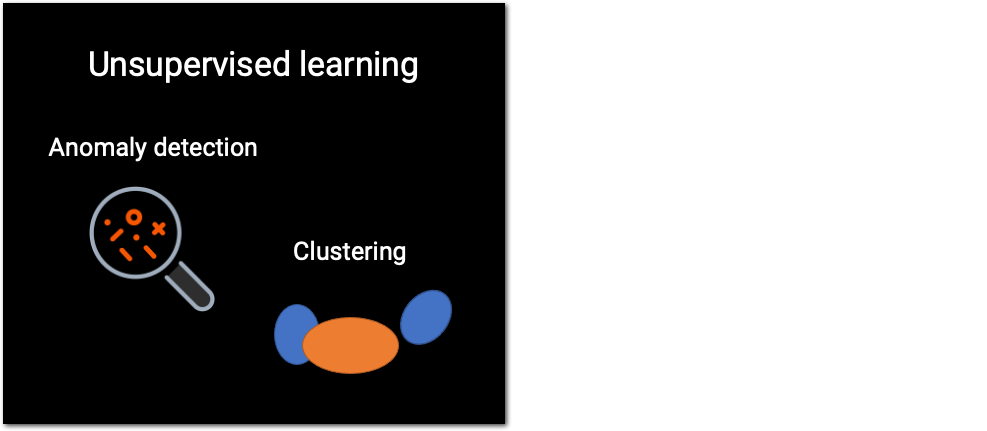
With unsupervised learning, the dataset is unlabeled and the algorithm must infer patterns in the data.
-
In an anomaly detection experiment, the algorithm detects unusual data points in your dataset. Potential uses include the detection of fraudulent transactions, faults in hardware, and human error during data entry.
-
In a clustering experiment, the algorithm splits the dataset into groups according to similarity. Clustering is useful for gaining intuition about your data. The clusters can also help label your data so that you can then use a supervised learning method on the dataset.
Time-aware modeling
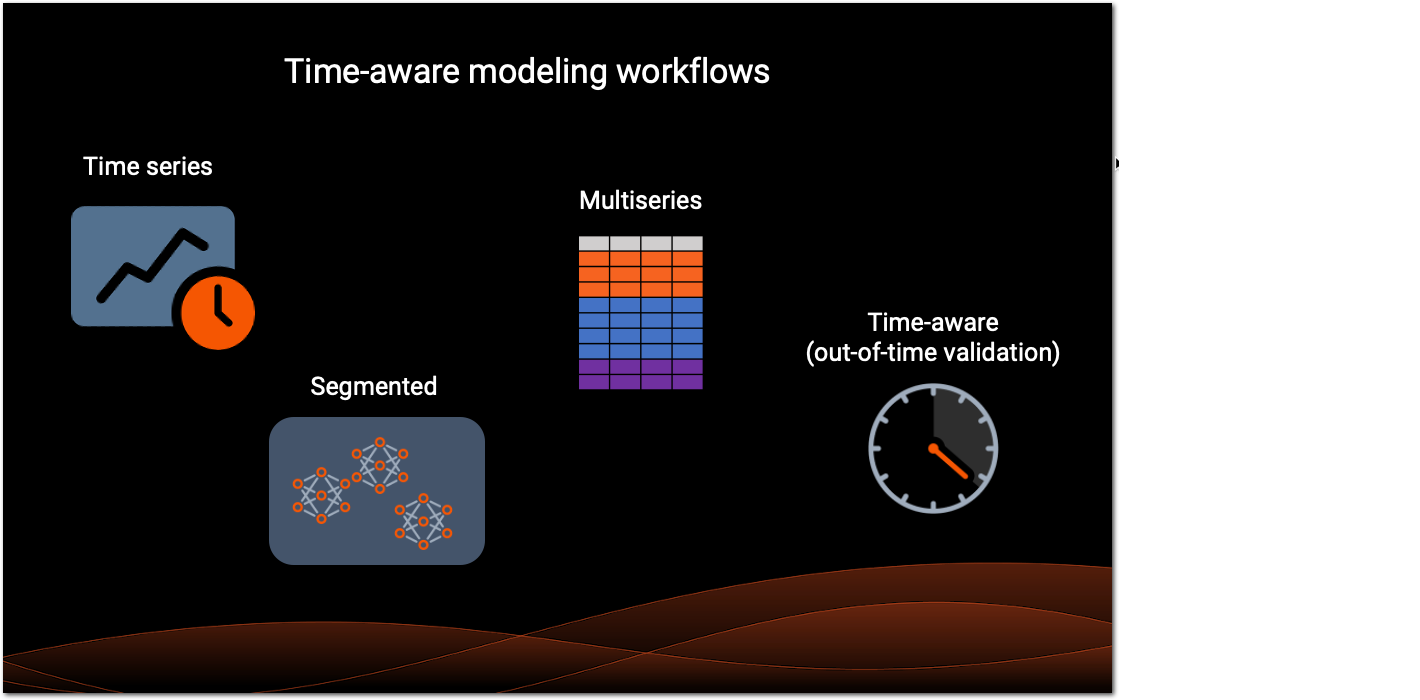
Time data is a crucial component in solving prediction and forecasting problems. Models using time-relevant data make row-by-row predictions, time series forecasts, or current value predictions ("nowcasts"). An experiment becomes time-aware when, if the data is appropriate, the partitioning method is set to date/time.
-
With time series modeling, you can generate a forecast—a series of predictions for a period of time in the future. You train time series models on past data to predict future events. Predict a range of values in the future or use nowcasting to make a prediction at the current point in time. Use cases for time series modeling include predicting pricing and demand in domains such as finance, healthcare, and retail—basically, any domain where problems have a time component.
-
You can use time series modeling for a dataset containing a single series, but you can also build a model for a dataset that contains multiple series. For this type of multiseries experiment, one feature serves as the series identifier. An example is a "store location" identifier that essentially divides the dataset into multiple series, one for each location. So you might have four store locations (e.g., Paris, Milan, Dubai, and Tokyo) and therefore four series for modeling.
-
With a multiseries experiment, you can choose to generate a model for each series using segmented modeling. In this case, DataRobot creates a deployment using the best model for each segment.
-
Sometimes, the dataset for the problem you're solving contains date and time information, but instead of generating a forecast as you do with time series modeling, you predict a target value on each individual row. This approach is called time-aware predictions.
See What is time-aware modeling? for an in-depth discussion of these strategies.
Specialized modeling workflows
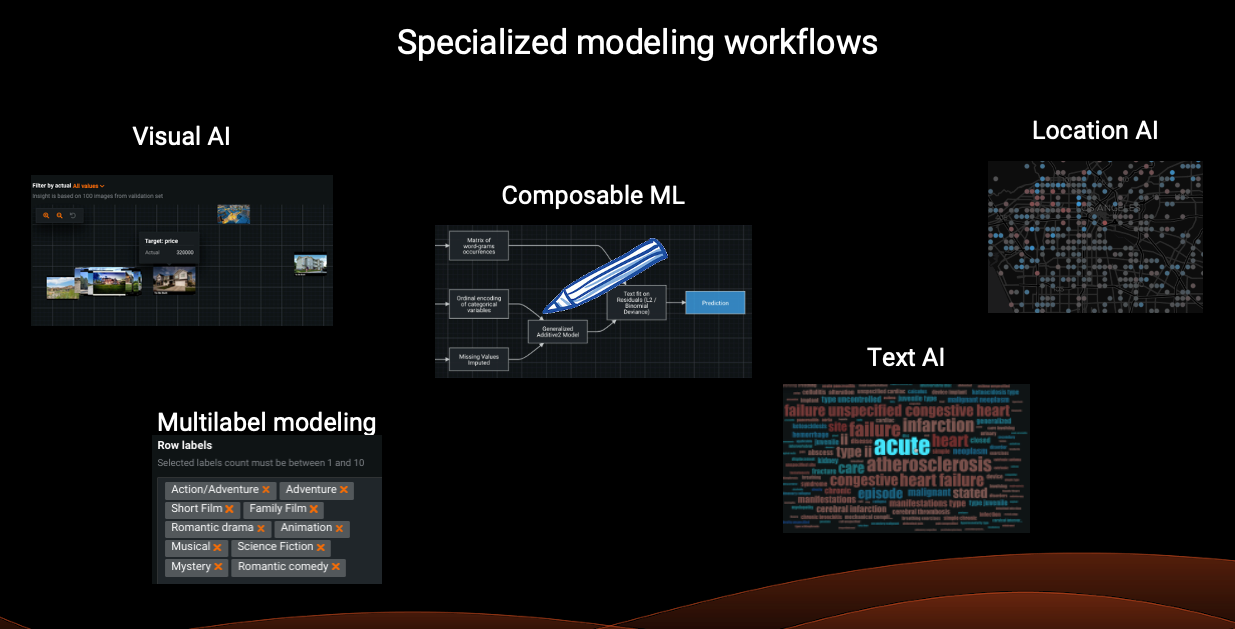
DataRobot provides specialized workflows to help you address a wide range of problems.
-
Image augmentation allows you to include images as features in your datasets. Use the image data alongside other data types to improve outcomes for various types of modeling experiments—regression, classification, anomaly detection, clustering, and more.
-
With editable blueprints, you can build and edit your own ML blueprints—the preprocessing steps (tasks), modeling algorithms, and post-processing steps that go into building a model—incorporating DataRobot preprocessing and modeling algorithms, as well as your own models.
-
For text features in your data, use Text AI insights like Word Clouds to understand their impact.
-
Location AI supports geospatial analysis of modeling data. Use geospatial features to gain insights and visualize data using interactive maps before and after modeling.
See the generalized discussion of the steps to build predictive models in Workbench. Or, try it yourself with the model building how-to.
Sample use cases
DataRobot was designed to unify complex enterprise environments across a variety of industries. The following descriptions provide 10,000-foot descriptions of how some DataRobot customers work with predictive AI. The fast facts reflect actual usage statistics from 2023.
Insurance use cases
-
A large multinational insurance company uses DataRobot across the business for a number of use cases including within fraud detection, claims processing, and underwriting. For model development they are very actively experimenting, testing models, and performing explainability checks on the DataRobot platform. Using DataRobot they are able to bring these models successfully through their risk management process and once in production have realized massive value.
Fast facts
- Experimentation: More than a thousand projects and tens of thousands of models built.
- Production: Thousands of models deployed and managed with DataRobot MLOps.
- Predictions: Hundreds of millions to date, averaging tens of millions per month in batch and real-time modes.
-
A multinational insurer uses DataRobot in EMEA and Japan at considerable scale. DataRobot is key for their retention use cases, lead scoring and underwriting practice across the business.
Fast facts
- Projects/experiments: 750 and counting, with tens of thousands of models built.
- Models in production: Thousands of models deployed and managed with DataRobot MLOps.
- Predictions: Over 250M prediction rows from over 10,000 prediction requests.
-
A large re-insurer is impressed with how DataRobot removes friction from building models and serving predictions. Use cases include predicting unpaid invoices to optimize overdue invoice collections and predicting market prices, taking quotes from quote aggregators to determine when competitors implemented pricing changes. They have used DataRobot's managed SaaS product, so they do not have to think about compute availability and can instead focus on data science outcomes for hundreds of users.
Fast facts
- Projects/experiments: Over 15,000 and growing.
- ML models built: In the range of 200,000.
- Predictions: More than one billion on DataRobot's high-performance prediction servers.
Healthcare use case
A global pharmaceuticals giant uses DataRobot to improve business efficiency. They use DataRobot to:
- Forecast demand in North America and EMEA
- Predict propensity to buy in the US
- Predict IT tickets
- Perform content recommendations.
Manufacturing use case
-
One of the world’s largest building materials manufacturers uses DataRobot for predictive maintenance. Models predict failures of critical production equipment. Among other use cases, predictive maintenance models help avoid unplanned stoppages of critical production lines, minimizing financial losses.
The team builds, retrains, and manages models in DataRobot. Models are then deployed to edge devices at plant sites as Scoring Code, one of the DataRobot portable prediction methods. Scoring Code runs locally, close to the equipment, without calling DataRobot prediction servers. Each plant receives a dedicated model package per equipment type.
Fast facts
- Use case: Predictive maintenance of critical production equipment.
- Deployment: Scoring Code on edge devices across dozens of plants.
- Modeling: DataRobot is used to train individually per plant and equipment type.
- Lifecycle: Models are actively maintained, retrained, and redeployed from DataRobot.
Retail use cases
-
A freight company uses DataRobot to assist their freight, supply chain, and forwarding businesses, with 170+ active users on the platform from multiple divisions. They use DataRobot to forecast incoming calls and improve workforce planning, predict possible thefts in parcel centers, forecast total volume of packages entering certain countries, and predict financial KPIs. They have seen how the experiments and models built on DataRobot outperform forecasting models built outside the platform. They have experienced a 50%+ error reduction on key use cases. Accuracy improvements have allowed them to move from monthly to weekly—and even daily—predictions with granular breakdowns.
-
One of Europe’s largest media companies has been a DataRobot customer since 2018. They use their deployed models for demand optimization, targeted advertising, and content management. They recently extended their prediction environment to support large-scale batch predictions for audience segmentation and ad targeting. The team is leveraging the DataRobot/Snowflake integration capabilities to maintain a computationally intensive predictive pipeline and complete weekly scoring on time. DataRobot enables the small data science team to work more efficiently and with greater accuracy, bringing models live faster than before and achieving incremental revenue gain with optimized inventory management.